
ShieldPro Flexible Packaging — Technical Reference Guide (Oxygen Absorbers) -
Quick Answer to How Much Should I use? (TL;DR)
Official DMB recommendation:
Dense food = 300cc.
Bulky/freeze-dried = 500cc.
Unsure = 500cc.
For a standard 5-gallon bucket, use one Freshus or Oxyfree 2000cc oxygen absorber per properly filled 5 gallon bag.
What Is an Oxygen Absorber?
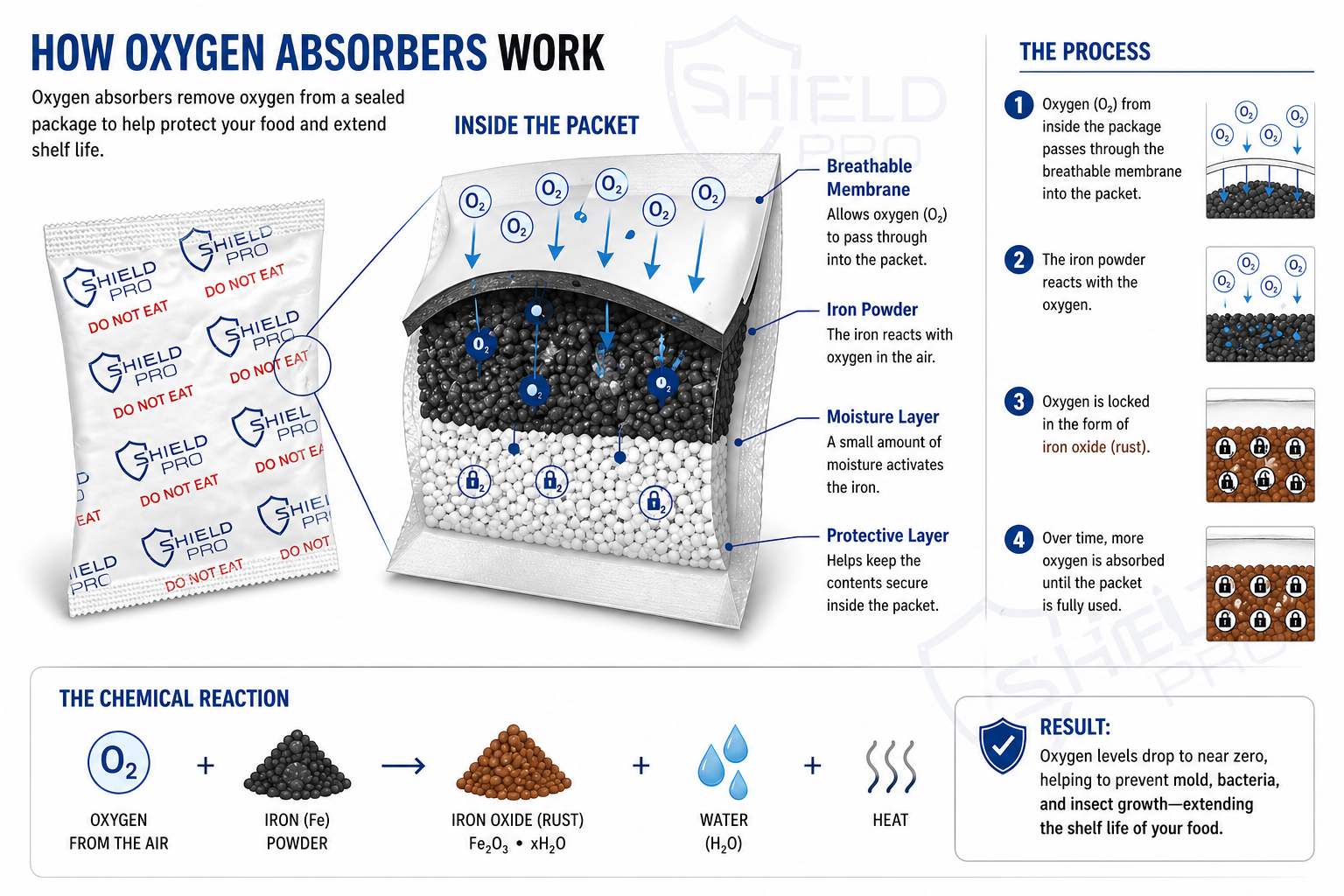
An oxygen absorber is a small packet containing iron powder that reacts with oxygen inside a sealed container. As the iron oxidizes, it removes oxygen from the environment, reducing it to near zero levels.
This helps:
- Prevent mold and bacteria growth
- Stop insect activity (eggs cannot hatch without oxygen)
- Extend shelf life of dry foods
How Oxygen Absorbers Work
Oxygen absorbers remove oxygen only—not air.
Air is approximately:
- 21% oxygen
- 78% nitrogen
- 1% other gases
After sealing:
- Oxygen is removed
- Nitrogen remains (harmless and inert)
In most cases, your bag should vacuum down tight, especially with dry goods like rice and beans. This is called ‘printing’. However, powdery foods like flour or powdered eggs won’t print at all. Many freeze-dried foods should also print, but some won’t due to their higher internal air space or if you store less in a bag to avoid crushing. If none of your food is printing, there may be a problem. If you feel any tightening of your bag, your food is stored properly.
Oxygen Absorber Size Chart (Most Common Use Cases)
|
Container Size |
Food Type |
Recommended CC |
|
1 Pint (2 cups) |
Dry goods |
50–100cc |
|
1 Quart |
Dry goods |
100cc |
|
1 Gallon |
Dry goods |
300cc |
|
#10 Can |
Dry goods |
300cc |
|
5 Gallon Bucket |
Dry goods |
2000–2500cc |
? When in doubt, round up—not down.
Exact Sizing Formula (For Precision Use)
Step 1: Estimate Container Volume
1 gallon = 3,785 cubic centimeters (cc)
Step 2: Calculate Oxygen Volume
Oxygen = ~21% of air
Formula:
Container Volume (cc) × 0.21 = Oxygen Volume (cc)
Step 3: Adjust for Food Displacement
Food reduces available oxygen space.
Typical rule:
- Densely packed foods (rice, beans): use ~30% of calculated oxygen
- Loose foods (pasta, cereal): use ~50% of calculated oxygen
Example (1 Gallon of Pasta)
- Total volume: 3,785cc
- Oxygen portion:
3,785 × 0.21 ≈ 795cc oxygen - Adjust for density (~50%) 795cc*.5=398cc:
≈ 500cc needed
✅ Result: Use 500cc absorber
Important Factors That Affect Sizing
- Headspace
More empty space = more oxygen
? Larger bags need more absorbers even with same food weight
- Bag Quality (CRITICAL)
Low-barrier bags allow oxygen to slowly re-enter.
Key metric:
- OTR (Oxygen Transmission Rate)
Lower OTR = better long-term storage
This is why true Mylar (BoPET/VMPET) outperforms bags with only LLDPE as their contact layer. Bags with a good aluminum foil layer and Mylar as the food contact layer are best. Only a few companies still use Mylar in their construction; most have replaced it with cheaper layers.
- Seal Quality
Even perfect sizing fails with a bad seal.
- For best results, use an impulse heat sealer and never rely just on a zip seal
- Seal quickly after adding absorbers
- Look for oxygen absorbers with a higher initial capacity (for example, some 300cc oxygen absorbers use that number as a baseline, and offer ‘300% initial capacity’ or 900cc, as their starting point) and they will use a lower percentage of their overall absorption while you work
- Absorber Age / Exposure
Oxygen absorbers start working immediately when exposed to air.
Once opened:
- If you don’t know how much initial capacity your oxygen absorbers, assume they don’t have any and use within 10–20 minutes
- Reseal extras in an airtight container (mason jar with ring and seal lid, or a small Mylar bag)
Common Mistakes (Avoid These)
❌ Using Too Small Absorbers
Most common failure point
? Leads to mold, bugs, and spoilage
❌ Using With Moist Foods
Oxygen absorbers + moisture = botulism risk
Never use with:
- Fresh foods
- Wet or oily foods
- High-moisture items
❌ Relying on Vacuum Seal Alone
Vacuum sealers remove some air, not all oxygen.
? For long-term storage:
Use oxygen absorbers + Mylar
❌ Not Accounting for Food Type
Pasta ≠ rice
Air pockets matter more than weight
FAQ
Can you use too many oxygen absorbers?
No. Excess absorbers are harmless—they simply won’t fully react.
What happens if you use too few?
Oxygen remains, leading to:
- Spoilage
- Insect activity
- Reduced shelf life
Do oxygen absorbers expire?
Yes (typically 6–12 months unopened).
They must be stored in airtight packaging until use.
How do I know if they’re still good?
Fresh absorbers:
- Feel soft or powdery
Used/exhausted absorbers:
- Feel hard or solid
Do you need oxygen absorbers for sugar or salt?
No.
They can cause:
- Sugar to harden
- Salt to clump
Is it true you can’t use an oxygen absorber with a desiccant?
No, this is one of the longest running internet myths about food storage. There are no verifiable tests showing that desiccant will cancel an oxygen absorber, even from the person who suggested it. Plus, there are several companies who have run tests (Including ours) proving they work together just fine.
Practical Recommendations
- Always round up your CC amount
- Use high-barrier Mylar bags (low OTR)
- Seal immediately after inserting absorbers
- Label contents + date
Technical Notes
- Oxygen content of air: ~20.95%
- 1 gallon = 3,785cc
- OTR varies by material and thickness
- Calculations assume dry food (<10% moisture)
Bottom Line
If you remember one rule: For one gallon, use:
Dense food = 300cc.
Bulky/freeze-dried = 500cc.
Unsure = 500cc.